


Quick Answer: The 2-bedroom villa layout consistently delivers the highest net ROI in Bali’s rental market, typically 14%–18% per year, because it balances a moderate construction budget with the widest possible guest demographics and the strongest daily rate-to-cost ratio. That said, the “right” layout depends entirely on your land budget, target zone, and exit strategy. This guide breaks down all three configurations from a builder’s perspective, with real construction cost ranges, spatial efficiency data, and layout strategies we’ve applied across our Bali villa projects.
Most foreign investors approach bedroom configuration as a lifestyle question, “How many people will stay here?”, rather than the capital efficiency problem it actually is.
As a design and build contractor operating across Bali, ASA Group Indonesia has built and analyzed villa configurations across Canggu, Seminyak, Uluwatu, and Pererenan. The comparison below is built on our direct construction cost data and post-occupancy financial performance, not broker projections.
Related Reading: Before locking in a configuration, understand the zoning rules that govern what you can build, and where. See our guide: Bali Property Development: Navigating Zoning Laws for Your Villa Project
1 vs 2 vs 3 Bedroom Bali Villa: Side-by-Side Comparison
| Metric | 1-Bedroom | 2-Bedroom | 3-Bedroom |
| Land Required | 1.0–1.5 Are (100–150 m²) | 1.5–2.5 Are (150–250 m²) | 3.0–5.0 Are (300–500 m²) |
| Build Area | 70–90 m² | 120–160 m² | 200–280 m² |
| Est. Build Cost (USD) | $65,000–$95,000 | $110,000–$170,000 | $180,000–$290,000 |
| Est. Daily Rental Rate | $110–$180 | $200–$350 | $380–$650 |
| Typical Occupancy | 80%–85% | 75%–80% | 60%–70% |
| Est. Net Annual ROI | 12%–15% | 14%–18% ✓ Sweet Spot | 10%–14% |
| Primary Guest Profile | Couples, Digital Nomads, Solo Travelers | Families, Two Couples, Remote Workers | Luxury Groups, Family Reunions, Retreats |
| Upfront CapEx Level | Low | Moderate | High |
Build cost estimates reflect mid-to-high-end developer standards in Bali as of 2026. Figures vary by soil conditions, structural complexity, and finishing material selections. As of 2026, luxury villa construction in Bali ranges from approximately USD 700–1,100 per square meter, depending on these variables.
Understanding CapEx vs. OpEx: Where Most Investors Go Wrong
To calculate true net ROI, not the gross yield figures brokers typically present, you must separate two distinct cost buckets.
Capital Expenditure (CapEx): Your Build-Stage Cost
CapEx is determined by your villa’s spatial footprint and structural complexity. In Bali specifically, geological conditions add significant variability: clay-heavy soils in Canggu require deeper, more expensive pile foundations, while Uluwatu’s limestone bedrock demands specialized excavation.
Scaling from 1BR to 3BR is not a linear cost increase. Every additional bedroom expands your:
- Concrete structural volume (slabs, columns, beams)
- Electrical distribution panel capacity
- Septic tank and deep-well water system size
- Roof surface area (one of the most weather-exposed, maintenance-intensive components in a tropical climate)
Smart investors use value engineering to keep CapEx predictable. For example, specifying premium local Bengkirai hardwood for decking instead of imported teak, or using high-grade local terrazzo instead of imported marble, can reduce finishing costs by up to 40%, with no perceptible drop in guest experience.
Operational Expenditure (OpEx): The Silent ROI Killer
Bali’s tropical climate, intense humidity, salt-laden coastal winds, and a concentrated wet season from October through March, is uniquely destructive to villa interiors. Open-concept living areas accelerate the deterioration of:
- Soft furnishings (sofas, cushions, mattresses)
- Wood elements (furniture, ceiling joists, door frames)
- Consumer electronics (smart TVs, audio systems)
- Structural paint and sealant layers
Air conditioning is the single highest monthly utility expense in any Bali rental villa. The open vs. enclosed living layout debate is therefore not aesthetic, it’s financial. Enclosing your living and dining areas with high-performance aluminum-framed glass sliding doors allows guests to efficiently cool the space, reducing monthly electricity costs by up to 30% while protecting interior assets from rapid tropical wear. Over a 15–25 year leasehold period, this single layout decision has a compounding impact on your net yield.
Further Reading: Discover the most common mistakes investors make before construction begins: Bali Property Investment Pitfalls: A Guide to Safe and Smart Decisions
1-Bedroom Bali Villa: High Occupancy, Capped Revenue
Who It’s Right For
A 1-bedroom villa is the lowest barrier to entry in Bali’s investment property market. It targets the island’s largest and most consistent traveler segment: couples, solo digital nomads, and short-stay vacationers. According to Bali Tourism Board data, Bali welcomed over 6.3 million foreign visitors in 2024, with the majority being couples or solo travelers booking stays of three to five nights, exactly the profile that books 1-bedroom villas.
The trade-off is a hard revenue ceiling. Because the 1-bedroom segment is the most competitive category on OTA platforms like Airbnb and Booking.com in Bali, daily rates are constrained by market saturation, particularly in Canggu and Seminyak.
Optimal Layout Strategy for 1BR Villas
On a footprint of 1.0–1.5 are, we recommend one of two configurations:
Loft-style single-volume layout: Merges the bedroom and living area into a single open-plan space, creating the perception of generous square footage on a compact land parcel.
Pool-integrated bedroom layout: Floor-to-ceiling glass sliding doors open directly from the bedroom onto a plunge pool, eliminating the need for a separate outdoor terrace. This dramatically improves spatial efficiency and produces the “Instagram-worthy” visual that drives organic bookings.
Placing the bathroom partially outdoors, with vertical tropical landscaping, saves indoor area while reinforcing the island-living aesthetic that commands premium rates on social media-driven booking platforms.
1BR ROI Summary
| Net Annual ROI | 12%–15% |
| Occupancy | 80%–85% (most stable category) |
| Key Risk | Price compression in saturated zones during low season |
| Best Zone Match | Uluwatu cliffs, Ubud rice fields, emerging areas (lower competitor density) |
2-Bedroom Bali Villa: The Highest ROI Configuration in Bali
Why the 2BR Is the Undisputed Sweet Spot
The 2-bedroom villa captures the intersection of three critical advantages: manageable construction cost, high daily rental rates, and the widest possible guest demographic. It is the only configuration that can serve couples, families with children, two traveling friends sharing costs, and remote workers seeking a private workspace, often within the same month.
This versatility is what drives superior occupancy resilience across seasons. Unlike the 1BR (which struggles during low season due to competition) or the 3BR (which needs high-paying group bookings to justify its operational overhead), the 2BR maintains consistent demand from multiple independent traveler segments year-round.
The economics are compelling. Adding a second bedroom increases your construction cost by 30%–50% over a 1BR. But your achievable daily rental rate jumps by 60%–95%. That asymmetry, where revenue growth significantly outpaces cost growth, is the core of the 2BR investment thesis.
Optimal Layout Strategy for 2BR Villas
On 1.5–2.5 are of land, we implement one of two proven configurations:
L-Shape Layout: One bedroom occupies each arm of the L, with the central pool positioned at the corner. Both bedrooms receive direct pool views and natural light without sharing a common wall, critical for guest privacy when renting to two separate couples.
Split-Bedroom Layout: Bedrooms are positioned on opposite sides of a fully enclosed central living and dining pavilion. The pavilion serves as a shared common area while the bedrooms remain acoustically independent. This configuration is particularly popular with family groups.
Key detail: Enclosing the central living area with smart pocket-sliding glass doors is non-negotiable for maximizing ROI. It enables climate-controlled guest comfort, reduces electricity waste, and protects interior furnishings from Bali’s humidity, all of which translate directly into lower OpEx and higher guest review scores.
2BR ROI Summary
| Net Annual ROI | 14%–18% (highest across all configurations) |
| Occupancy | 75%–80% |
| Key Advantage | Broadest guest demographic; resilient across both peak and low seasons |
| Best Zone Match | Canggu, Pererenan, Seminyak, Uluwatu (all high-demand zones) |
You can see how this layout principle is applied in our completed projects, including OceaniQ Villas in Nusa Dua, a development where spatial efficiency and enclosed living design were central to the investment brief.
3-Bedroom Bali Villa: Maximum Revenue Potential, Premium Demands
Who It’s Right For
The 3-bedroom villa targets the luxury end of Bali’s rental market: extended family vacations, corporate retreats, yoga and wellness groups, and destination events. It commands the highest nightly rates on the island, $380–$650 per night for a well-positioned property, and can generate exceptional cash flow during peak holiday periods (July, August, Christmas/New Year).
The challenge is operational complexity. A 3BR villa requires dedicated on-site staff for housekeeping, pool maintenance, and guest services. Its larger footprint means higher utility costs, more surface area exposed to tropical weathering, and a longer guest procurement cycle (higher nightly rates require more lead time in booking).
Occupancy consistency is the primary risk. If a 3BR villa sits empty for 30%–40% of the year, which is common in the low season without strong marketing, its net yield drops sharply.
Optimal Layout Strategy for 3BR Villas
On 3.0–5.0 are, we recommend either:
Two-story layout: Bedrooms distributed across two floors, preserving maximum outdoor garden and pool area on the ground level. More architecturally complex but delivers higher land-use efficiency in premium zones where land cost is the single largest expense.
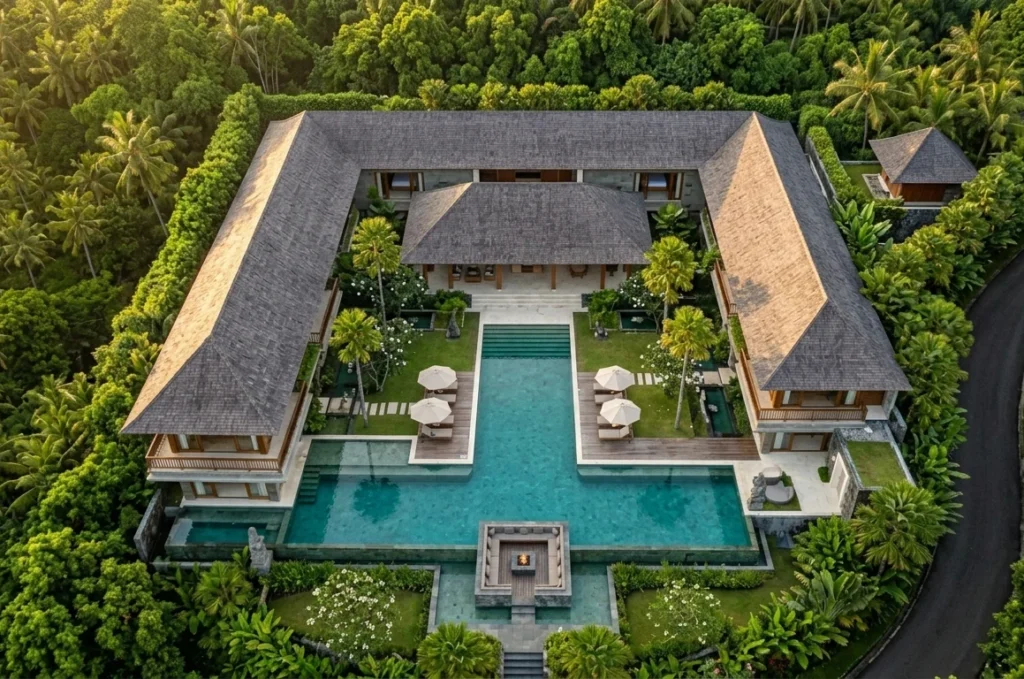
Single-story U-shape: All three bedrooms arranged around a central garden and pool axis. Lower construction complexity, excellent privacy between rooms, and a resort-like guest experience at ground level.
The Lock-Off Strategy (our most effective tool for 3BR ROI optimization):
By incorporating dual-key entry points and acoustic partition walls during the construction phase, a 3BR can be subdivided into a fully self-contained 2BR villa and an independent 1BR studio. During low-season booking slumps, rather than leaving the entire property vacant, you lease the two units separately, effectively running two revenue streams from one land title. This single layout decision can prevent 3–5 months of near-zero revenue per year.
3BR ROI Summary
| Net Annual ROI | 10%–14% |
| Occupancy | 60%–70% |
| Key Risk | High CapEx + seasonal demand dependency; requires strong marketing |
| Best Zone Match | Uluwatu clifftop, Seminyak prestige zones, Nusa Dua resort areas |
The Open vs. Enclosed Living Debate: A Financial Framework
This is one of the most consequential layout decisions across all three bedroom configurations, and it is consistently underestimated by both architects and investors.
Open living (traditional Balinese bale style):
- Higher aesthetic appeal in architectural renders
- No air conditioning efficiency, the space cannot be climate-controlled
- Accelerates deterioration of soft furnishings, wood elements, and electronics
- Higher annual replacement costs for interior assets
Enclosed living (high-performance glass-door system):
- Enables full climate control → up to 30% lower monthly electricity costs
- Protects interior assets → significantly lower annual OpEx for furniture and electronics replacement
- Guest preference data on luxury OTA platforms strongly favors air-conditioned living spaces
- Requires upfront investment in quality aluminum framing and multi-track sliding glass systems
Over a 10–25 year leasehold term, the difference in compounded OpEx savings between these two approaches can be equivalent to 2–4 years of additional net rental income.
Zoning, Land, and Location: Variables That Override Your Layout Choice
Even the most optimized 2BR layout will underperform if positioned in the wrong zone or on land with adverse soil conditions. Before committing to any bedroom configuration, verify:
Zoning Classification: Bali’s spatial planning regulations (RDTR) dictate building coverage ratios, height limits, and permitted uses. A parcel zoned for residential use may prohibit short-term rental operations entirely. See our detailed breakdown: Bali Property Development: Navigating Zoning Laws for Your Villa Project
Soil Condition Report: Clay soils in Canggu require deeper pile foundations. Limestone in Uluwatu requires specialized excavation. Both directly affect your CapEx budget.
Leasehold Term Remaining: For short-to-medium term ROI, leasehold (Hak Sewa) is almost always more capital-efficient than freehold (Hak Milik), because the land acquisition cost is dramatically lower. A longer remaining lease term (25+ years) materially improves your return profile. Indonesia’s Badan Pertanahan Nasional (BPN) provides the authoritative reference for property rights classification.
Rental License Requirements: Operating a villa commercially in Bali requires a PONDOK WISATA or similar short-term rental permit. Unlicensed operations are increasingly subject to enforcement action in 2025–2026.
Why now? Market conditions, construction costs, and land availability are all at a critical inflection point. Read our analysis: Bali Villa Opportunity: Why Now Is the Optimal Time for Construction
How ASA Group Indonesia Optimizes Your Layout Before Ground Breaks
At ASA Group Indonesia, we’ve learned that the most expensive mistakes in villa development happen before the first column is poured, in the design and structural planning phase.
Our engineering and estimating team reviews client blueprints against three specific criteria:
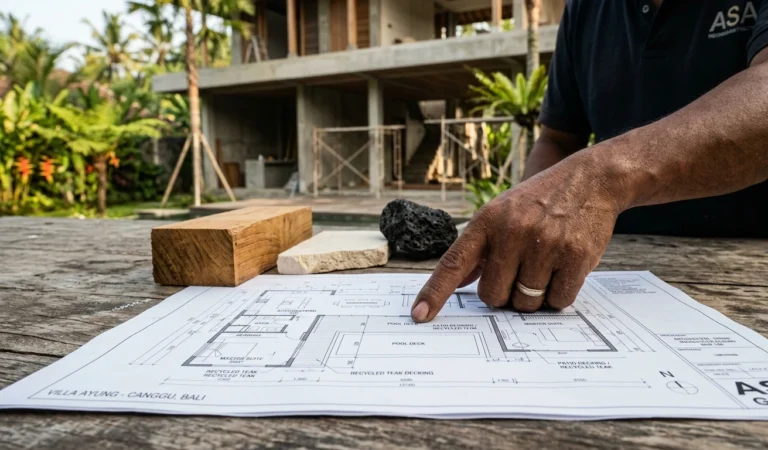
1. Spatial Efficiency Ratio: What percentage of your leased land area translates into rentable guest space? We identify and eliminate dead zones, oversized corridors, non-functional transitional spaces, and oversized bathrooms that add CapEx without adding nightly rate potential.
2. Structural Simplicity vs. Aesthetic Impact: Complex roof geometries, double-height ceiling volumes, and cantilevered pools are visually striking but drive non-linear increases in structural steel and waterproofing costs. We identify where design complexity delivers guest experience value and where it purely increases builder margins.
3. OpEx-Optimized Material Specification: We guide material selection toward high-performance local alternatives, premium Bengkirai for decking, local terrazzo for wet areas, locally sourced volcanic stone for feature walls, that deliver luxury aesthetics at 30%–40% lower cost than imported equivalents, while performing better in Bali’s climate.
View our completed villa and resort projects, including Satori Resort Nusa Dua, OceaniQ Villas, and ANTA Apartment Bali, in our full project portfolio.
If you are planning a villa development in Bali and want a structural review and cost-efficiency analysis of your layout before committing to construction, contact our team at ASA Group Indonesia, Bali Villa Contractor.
Frequently Asked Questions
Which villa bedroom count has the highest occupancy rate in Bali?
1-bedroom villas maintain the highest and most stable occupancy rates, typically 80%–85% year-round. The target guest profile, couples, solo travelers, and digital nomads, represents the largest segment of Bali’s inbound tourism. However, high occupancy does not automatically translate to high ROI; because daily rates are capped by intense market competition in the 1BR segment, net yield often trails that of 2BR villas with slightly lower but more profitable occupancy.
Is the 2-bedroom villa actually better than the 1-bedroom for ROI in Bali?
Yes, consistently, for most investor profiles. The 2BR delivers a higher daily rental rate (60%–95% more than a 1BR) for a construction cost increase of only 30%–50%. The resulting revenue-to-cost ratio produces a higher net annual yield (14%–18%) compared to the 1BR (12%–15%), while also offering better seasonal resilience due to a wider guest demographic.
What is the lock-off layout strategy for a 3-bedroom villa?
A lock-off layout incorporates a dual-key entry system and acoustic-grade partition walls during construction, allowing a 3-bedroom villa to be physically divided into two independently rentable units, typically a 2BR villa and a 1BR studio. This strategy protects 3BR owners from low-season occupancy drops by enabling multi-unit leasing during periods when a single group booking is unlikely.
Should I choose an open or enclosed living room layout for my Bali villa?
Enclosed living is strongly recommended for any villa targeting the modern short-term rental market in Bali. It enables full climate control (air conditioning), protects furniture and electronics from tropical humidity and salt air, and is the preferred guest experience for the luxury traveler segment willing to pay premium nightly rates. The upfront cost of a quality aluminum glass sliding door system is recovered through reduced electricity and furnishing replacement costs within 3–5 years.
What does it cost per square meter to build a luxury villa in Bali in 2026?
As of 2026, premium to luxury villa construction in Bali ranges from approximately USD 700–1,100 per square meter, depending on soil conditions (which affect foundation complexity), structural design choices (single vs. multi-story, flat vs. pitched roof), and the specification of finishing materials. Using local premium materials, terrazzo, Bengkirai wood, volcanic stone, instead of imported equivalents can reduce finishing costs by 30%–40% at equivalent aesthetic quality.
Is leasehold or freehold better for ROI in Bali?
For pure investment ROI on a 10–25 year horizon, leasehold (Hak Sewa) typically outperforms freehold (Hak Milik) because land acquisition cost is dramatically lower, which reduces your initial CapEx and accelerates your payback period. Freehold provides long-term asset ownership but comes at a significant price premium in Bali’s prime tourist zones, which compresses initial yield. Your choice should align with your exit strategy and investment horizon.
How do I build a villa in Bali as a foreigner?
Foreign nationals cannot hold freehold land title (Hak Milik) in Indonesia directly, but there are legal structures, including long-term leasehold (Hak Sewa), nominee arrangements via a PT PMA (foreign-owned company), or a Hak Pakai right of use, that enable foreign investment in Bali property. For a complete walkthrough of the process, read our comprehensive guide: How to Build a Villa in Bali: A Guide for Foreigners and Investors
The 2-bedroom villa layout remains the highest-ROI choice for the majority of investors entering Bali’s villa market in 2026. It minimizes land cost, keeps construction CapEx manageable, and unlocks the broadest guest demographic for year-round income.
But the right configuration is only as good as the structural plan behind it. Before you pour your foundation, have your blueprints reviewed by an engineering team that builds in Bali, not one that designs for it.
Contact ASA Group Indonesia for a structural review and cost-efficiency analysis of your villa layout: withasa.com/bali-villa-contractor